Business coaching for entrepreneurs: Grow your startup
A business coach works on the person running the company, not on the company itself. You bring the decisions you cannot discuss with anyone who has a stake in the answer. The coach asks the questions you have been avoiding, holds you to what you said you would do, and has no vote on the outcome. That is the whole job. Everything below is detail.
What a business coach actually does
Most founders arrive with a vague idea of the role. Is it a mentor, a consultant, a therapist? A good coach borrows a little from each, and the core is different from all three.
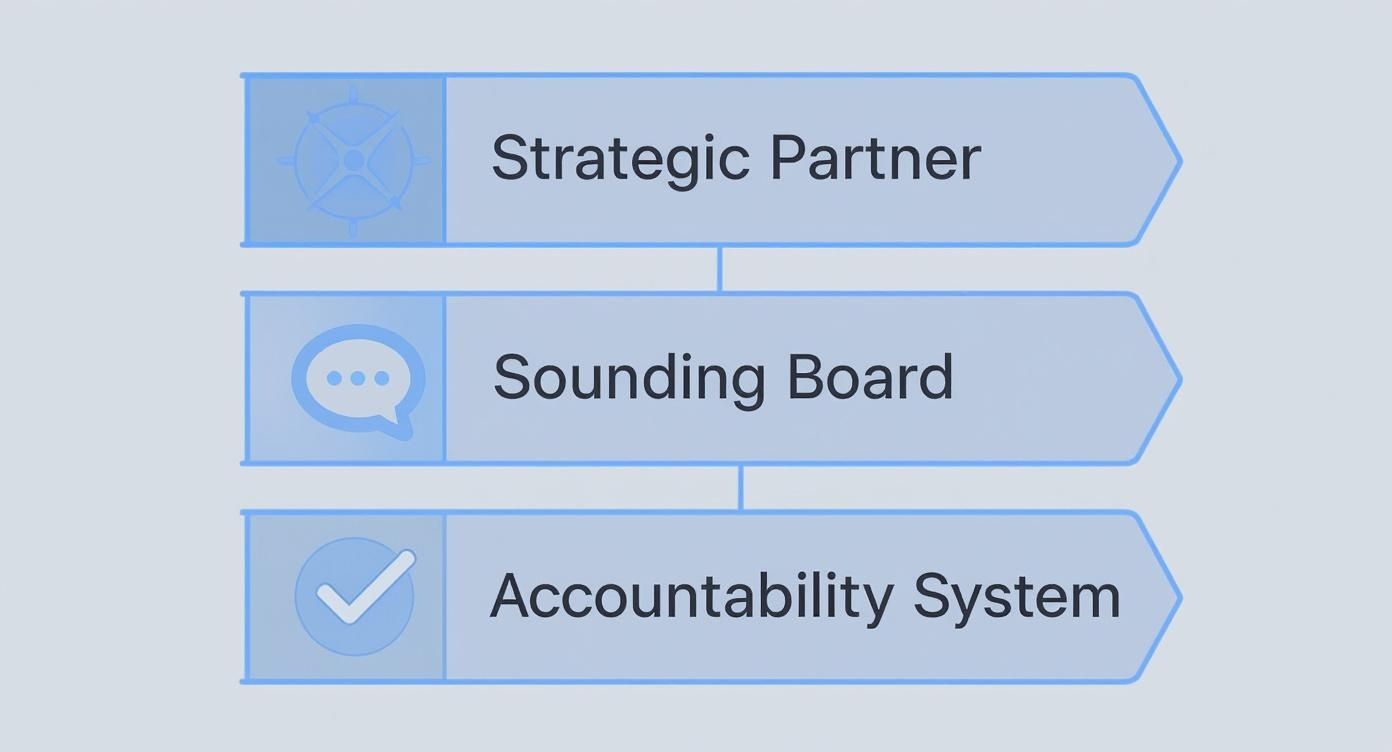
In practice, a coach is three things at once: a strategic partner, an impartial sounding board, and an accountability system. The coach does not hand you answers. Most of the time you already have the answer, and you have been sitting on it because saying it out loud makes it real. The session is where it gets said. Once it is said, the decision follows, and the coach makes sure it does.
The three roles
The value is in how quickly the coach switches between these, depending on what is in front of you that week.
- Strategic partner: helps you see the blind spot in the plan, test it, and decide what you are not going to do.
- Sounding board: a confidential place to say the thing you cannot say to your team, your board, or your investors. Nothing leaves the room.
- Accountability system: you said you would have the conversation with your co-founder by Friday. Did you?
If you want the mechanics of the profession itself, this guide on how to start an online coaching business covers it from the coach's side.
Business coach vs other advisors
Founders mix these up all the time, and the mix-up costs money. Each one solves a different problem.
The short version: a consultant gives you a fish, a mentor tells you where they caught one, a coach makes you go fishing and asks why you keep avoiding the lake. I wrote more on the mentor side in what is a founder mentor.
Coaching builds your capacity as a leader. It is a structured relationship with one focus: you, and the company as it depends on you. For a founder scaling a company, that outside view is the thing nobody inside can supply.
What it does for a Danish founder

Coaching is easy to describe in the abstract and hard to justify in a budget meeting. So here is what it does, in the terms a founder cares about: better decisions, a team that follows you, and a company that survives pressure without you breaking first.
Clarity
You are drowning in noise. Every week brings a new opportunity, a new fire, a new person who needs ten minutes. One of the first things a coach does is act as a filter. You bring the twelve good ideas. You leave with the two that matter and a reason for saying no to the other ten.
"The essence of strategy is choosing what not to do." Michael Porter
Once the vision is clear, the calendar can follow it. Time, money, and the team's attention all get pointed at the same thing. Most founders have never done that exercise with someone who will push back.
Leadership and decisions
A good idea gets you started. Scaling is a test of whether you can lead people and make sound decisions when tired, scared, or both. Coaching gives you a place to practise that, with direct feedback on how you come across, where you delegate and where you hover, and which conversations you keep postponing.
This matters in Denmark, where many founders in the Global Entrepreneurship Monitor's Denmark profile expect to create six or more jobs within five years. That growth needs a leader from the first hire, not from the fiftieth.
Accountability
A plan without execution is a daydream. The coach turns the plan into steps and then asks about the steps. It sounds simple. It is also the part most founders have never had, because nobody above them is checking.
In practice this looks like:
- Breaking goals down: the big scary objective becomes a list of things to do this week.
- Tracking the right numbers: the ones that say whether the company is healthy, not the ones that look good in a deck.
- Honest feedback: what moved, what did not, and why, without the politics you get from anyone on payroll.
The rhythm of check-ins is what builds momentum.
Staying in the game
Building a company is a marathon, and the toll is physical as much as mental. I burned out in 2019 by ignoring my body, and in February 2020 it stopped me for twelve weeks. The board let me go while I was still in bed. A coach is a place to say "I am not sure I can keep doing this" before the body says it for you. I wrote more on that in CEO burnout recovery.
Which coaching model fits
Coaching is not one product. The right model depends on your goals, your budget, and your stage. Pick wrong and you waste money and a few months. Pick right and you skip a year of mistakes.
One-on-one
Private sessions, on a fixed day and time, where the whole hour is about you and the company. This is for founders with complex decisions in front of them: a pivot, a co-founder problem, a board that has started asking different questions. The trust builds over weeks, and that trust is what lets you get to the root of a problem instead of treating symptoms.
A one-on-one coach is a confidential partner for the decisions that make or break the company. That is the work that turns a good founder into a good CEO.
It is the largest investment of the three models, and for the founders who need it, the return is the clearest. More on how I run it: what is a founder coach.
Group coaching
A small group of founders meets regularly with a coach on shared problems. Less personal than one-on-one, and it has something one-on-one cannot give you: peers in the same trench. Hearing how another founder handled the same board conversation is worth a lot, and the group becomes a support network that outlasts the programme. I run a version of this called Table for Twelve. More on the format in masterminds for entrepreneurs.
Specialised and executive coaching
- Skills coaching: one skill, worked on hard. Public speaking, the sales pitch, negotiation.
- Executive coaching: for founders whose companies are scaling fast and who now need to run a leadership team, a board, and the politics that come with both. The move from founder to CEO is a different job, and most people are never taught it.
The right model is the one that solves the problem you actually have this quarter.
How coaches use frameworks
An experienced coach is not only a sounding board. They bring structure. Not motivational slogans, but tested models that turn a big goal into a sequence of decisions. I have my own, the Whole Human Framework, which measures four systems, work, body, mind, and relationships, because the company can only run as well as the person running it. The models below are older and more general, and most coaches use some version of them.
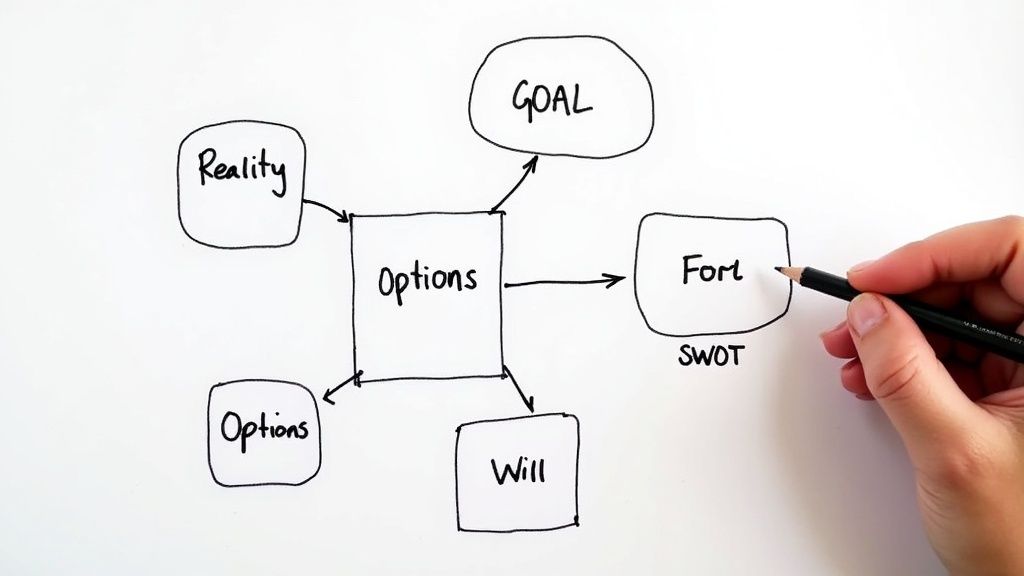
GROW
The simplest tool in the kit and still one of the best. Four stages, each one a question.
- Goal: what do you actually want? Not "grow revenue," but "close three enterprise clients and lift Q4 revenue 15 percent."
- Reality: where are you now, really? What is in your favour, what is in the way?
- Options: every route you can think of, including the ones you dismissed before you said them out loud.
- Will: what you commit to, by when, and who owns it.
Worked properly, GROW turns an ambition into a to-do list with dates.
SWOT and OKRs
Both are familiar. Both are usually done badly. A coach makes a SWOT honest, because a founder alone will write the weaknesses column with a soft pen. With OKRs, the coach's job is to keep the objectives ambitious and the key results measurable, so the team pulls in one direction and you can tell whether it worked. For other structured approaches, see startup scaling frameworks.
Mindset
Often the block is not the strategy. It is a belief the founder holds about themselves or the company. A Danish founder looking at Germany may think "we are too small to compete there." The coach's job is to test that belief, not to replace it with a slogan. Sometimes it is true, and the answer is to wait. Often it is not, and the smaller company is the faster one.
The context helps. Denmark ranks second in the EU for innovation performance, and Danish SMEs contribute a larger share of business turnover than the EU average, while the creation of larger companies has lagged. The details are in the European Innovation Scoreboard country profile. The gap between good small companies and few large ones is partly a leadership gap.
How to choose a business coach
This is one of the bigger hires you will make, and it is not a vendor decision. The right coach changes how you run the company. The wrong one is an expensive distraction with a monthly invoice.
Know what you need first
Before you look at anyone, get specific. Is the problem scaling the team, the business model, or your own head? Each needs a different person.
- The objective: revenue up 30 percent, a new market, a leadership team that runs without you?
- The gap: financial forecasting, strategy, or the way you lead?
- The outcome: what does six months from now look like if this works?
Do this before the first call. It is the difference between interviewing a coach and being sold by one. For early-stage founders, this piece on finding a startup business coach is a fair starting point.
Interview them
Treat the first conversation as a hiring interview where you hold the offer. Ask about their method, their history with companies at your stage, and how they know whether the work is working.
A good coach asks better questions than you expected. Pay attention to the questions, not the pitch.
Five questions to bring:
- What is your method?
- Have you run a company at my stage, or only coached ones?
- How do you measure whether this is working?
- Tell me about a client you could not help. What happened?
- What do you need from me for this to work?
Question four is the one to listen to. A coach who cannot name a failure is either new or managing you. I wrote a longer version of this in how do I choose a CEO coach.
Red flags
In Denmark, according to Statistics Denmark, only about 14 percent of owner-led companies have a formal advisory board. That means most founders have nobody with distance from the company looking at their decisions. It also means the coaching market attracts people who should not be in it. Walk away from anyone who:
- Guarantees results. Nobody can. Real coaches talk about the work.
- Runs one programme for everyone. Your problem is specific. The method should bend to it.
- Cannot show testimonials with names on them. Ask for two and call one.
- Talks more than you do on the first call. It will not get better.
Then trust your gut. If it feels off, it is.
Getting the most out of it
Hiring a coach is not like buying software. The return depends on what you bring. Show up ready to work, not to listen.
The mountain guide is the right picture. They know the route and the loose rock. You still walk every step.
Prepare
Arriving with nothing is like walking into a board meeting without your numbers. Ten minutes before each session, write three lines: what went well since last time, what got in the way, and what you need from this hour. That is the difference between a chat and a working session.
Say the real thing
A coach can only work on the problem you admit to. If you present the polished version, you get polished advice, and nothing changes. The most useful question in a first session is some version of "what have you not told anyone about this?" The founders who answer it get the most out of the work. I wrote about that hour in what happens in a first coaching session.
The change happens at the root, not the symptom. Getting to the root needs you to be honest with your coach about what is holding you back.
Do the work between sessions
The session is where the decision gets made. The week after is where it gets done. Treat the action items like a commitment to an investor: track them, report back, and be ready to say what did not work. More on this in working most effectively with a coach.
What it is worth
Three examples from my own clients, with the numbers they gave me.
One founder was about to make a senior hire at around 200,000 euros a year. We spent two sessions on what the role was actually for. The answer was a problem the founder was avoiding, not a gap in the team. The hire did not happen.
Another founder was planning a funding round for the following year. We looked at the numbers and the market and decided to go sooner. We spent the coaching time preparing for it. The round closed at 16 million dollars, Series A.
A third was evaluating a bolt-on acquisition, a smaller company to add to theirs. The financials worked. The people did not, and it took an outside view to say so plainly. They walked away and kept 4.5 million euros.
Against those, the fee is rarely the real question. Whether you are ready to say the real thing out loud is.
Common questions
How much does business coaching cost?
It depends on the coach's operating history, whether you buy sessions or a programme, and whether you or the company pays. One-on-one work with an experienced coach sits at the premium end, and group programmes cost a fraction of that. I publish every price I charge, and I keep the current market ranges on one page: how much does a founder coach cost.
What is the difference between a coach and a mentor?
A mentor shares their story. A coach makes you write yours. The mentor has done the thing and tells you how it went for them. The coach works on your judgment and holds you to your decisions, and the relationship is structured and paid. Both are useful. They are not the same purchase.
How long does an engagement last?
Three months is the shortest I would take seriously. That is long enough to make one real change and see whether it stuck. Many founders then continue at a lower cadence for a year or more, as the company grows and the problems change. The right length is the one that matches the problem, not the one on the price list.
How do I know if I am ready for a coach?
Most founders do not need one. You may, if:
- you are carrying decisions you cannot discuss with anyone who has a stake in the answer,
- working harder has stopped resolving them,
- you are heading into a transition: scaling the team, a new market, a round,
- you have started to suspect the limit on the company is you.
Readiness is willingness to be challenged and to do the work between sessions. If that describes you, you are ready. If you are not sure, read do entrepreneurs need a coach first. The honest answer there is "most do not."
I coach founders and CEOs of companies between 20 and 400 people. Six companies built, one burnout, 67 clients across 13 countries. If you want to see what working together looks like, start with services and pricing. Every price is on the page.